
The Needle and the Damage Done
Micky Gus
August 28, 2026
There’s something strange about people since Covid - not simply that they’re tired, distracted, or more isolated, but that a certain curiosity seems to have gone out of them.
It’s as if a part of the collective mind quietly switched itself off.
You see it in conversations. People seem less interested in asking questions. Less willing to follow an idea somewhere uncomfortable. Less interested in what is happening beyond the narrow perimeter of their own lives. There’s a kind of vacancy sometimes - a person is physically there, but intellectually and emotionally they seem to have retreated somewhere behind their eyes.
Maybe it’s exhaustion. Maybe it’s trauma. Maybe it’s the accumulated effect of several years in which reality repeatedly became stranger than the reality we had been promised.
Because Covid didn’t just disrupt people’s lives. It disrupted their assumptions.
For a lot of people, the world had always operated on an invisible contract: institutions were basically competent, experts basically understood what was happening, people thought they could trust the media, society was basically moving forward, and tomorrow would resemble yesterday closely enough that you could make plans.
Then, almost overnight, some of those assumptions proved to be paper-thin.
And perhaps the uncomfortable realization wasn't simply that institutions could be wrong.
It was that we had been using those institutions as psychological architecture.
They gave us something to lean against. They allowed us to say: Someone knows. Someone is watching. Someone understands. There is a system underneath all this.
But what happens when you begin to suspect there isn't?
Or worse - when you begin to suspect there is something underneath it, but you don't really understand what it is?
That can be an unbearable thought.
Because once you start looking behind the curtain, you don't necessarily find a satisfying explanation waiting for you. You find contradictions. Competing interests. Secrets. Incentives. Technology moving faster than culture can comprehend. Institutions protecting themselves. Information being manipulated. People believing things because they need to believe them. Things happening that don't fit neatly into the stories we've constructed to make the world comprehensible.
And then there's the sheer volume of strangeness.
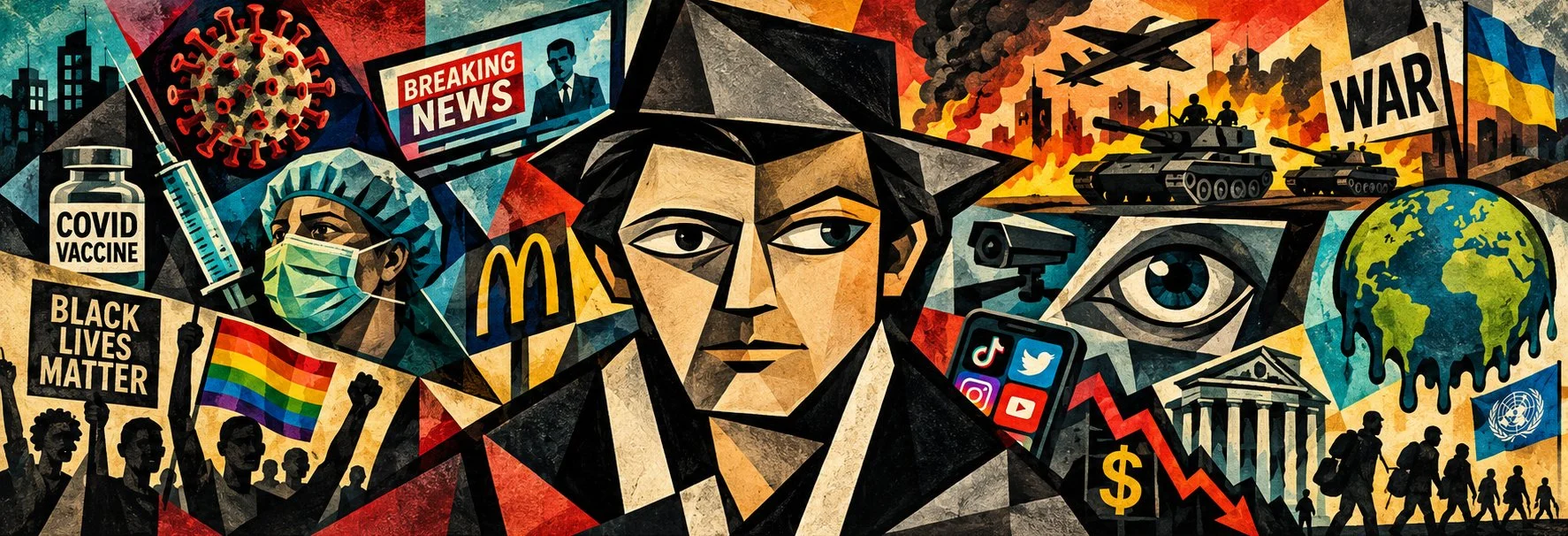
The world seems to have become increasingly difficult to categorize. Political reality feels surreal. Technology is advancing at a speed that makes the future feel like it's arriving without asking permission. AI is beginning to blur the distinction between something created by a person and something manufactured by a machine. UFOs and previously ridiculed questions have entered mainstream institutional conversations. Wars, economic instability, mass surveillance, algorithmic culture, synthetic media, ecological anxiety - the list keeps expanding.
You don't even have to believe any particular theory about any of it.
You only have to notice that reality has become harder to explain.
And perhaps that's part of what people are responding to.
Maybe they've simply reached the limit of how much uncertainty the human nervous system can metabolize.
So they shut down.
Not because they don't care.
Because caring has become exhausting.
Curiosity requires energy. It requires a willingness to have your assumptions disturbed. It requires admitting that you don't know. And if every answer seems to open five more questions, eventually the easiest psychological solution is to stop asking.
Scroll.
Work.
Buy something.
Watch something.
Post something.
Repeat.
Keep the machinery running.
Don't look too closely.
There may even be something compassionate about that withdrawal. Perhaps people are unconsciously preserving their sanity. There is a point where constantly interrogating reality ceases to be enlightening and starts becoming corrosive.
So the vacant expression might not represent stupidity or indifference.
It might represent self-protection.
A kind of psychological quarantine.
I don't want to know anymore.
I don't want to think about it.
I don't want to find out that the thing I trusted was never solid.
I don't want another contradiction.
I just want my little piece of reality to remain intact.
And maybe that's the saddest part.
Because curiosity is one of the things that makes us feel alive. The instinct to look around and say What the fuck is going on here? is not a defect. It's consciousness doing what consciousness does.
But when the world becomes sufficiently strange, curiosity can become frightening.
So people retreat into certainty.
They cling harder to their political tribe, their algorithm, their entertainment, their routines, their identities, their little explanations. Anything that keeps the walls standing.
Perhaps that's what we're witnessing: not a population that has stopped thinking, but a population that has thought itself to the edge of what it can comfortably bear and decided to stop looking.
The curtain has become visible.
And rather than pull it back, people are pretending they can't see it.
Because sometimes ignorance isn't ignorance at all.
Sometimes it's a survival mechanism.
But... let's have a little peek anyway.
THE AGE OF CHAOS
Thoughts and observations from somewhere between the human and the machine, the beautiful and the broken, the signal and the static.