

The Needle and the Damage Done
Micky Gus
August 28, 2026
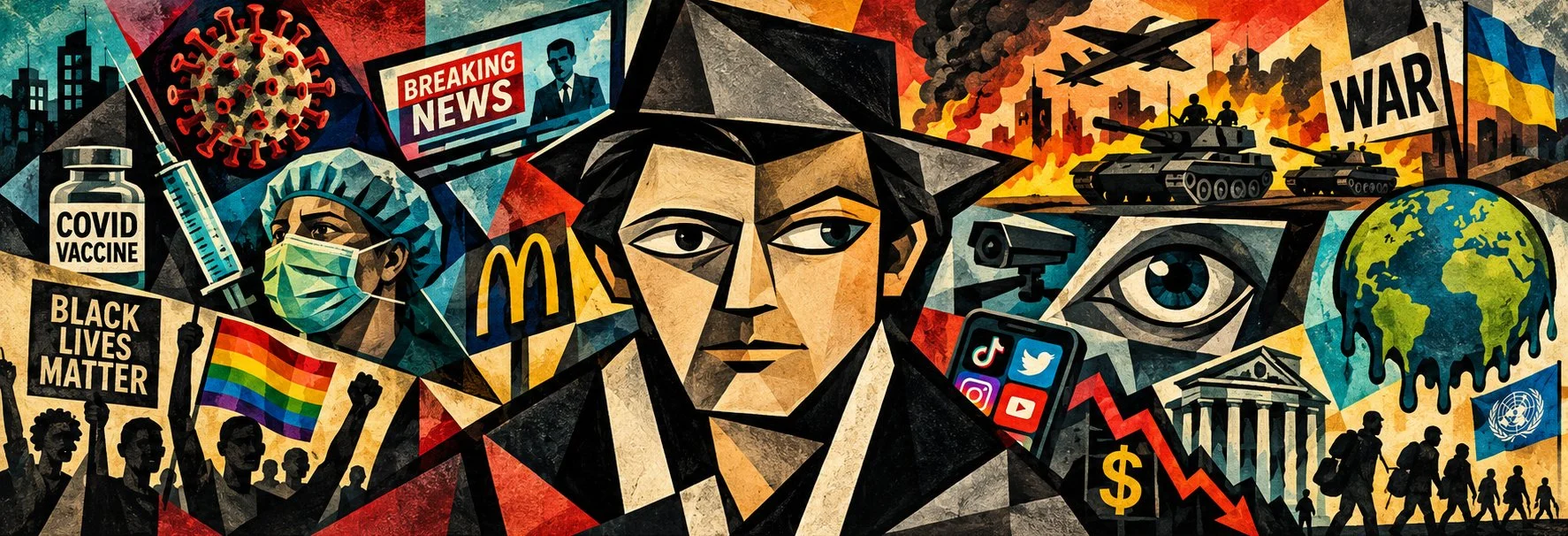
There’s something strange about people since Covid - not simply that they’re tired, distracted, or more isolated, but that a certain curiosity seems to have gone out of them.
It’s as if a part of the collective mind quietly switched itself off.
You see it in conversations. People seem less interested in asking questions. Less willing to follow an idea somewhere uncomfortable. Less interested in what is happening beyond the narrow perimeter of their own lives. There’s a kind of vacancy sometimes - a person is physically there, but intellectually and emotionally they seem to have retreated somewhere behind their eyes.
Maybe it’s exhaustion. Maybe it’s trauma. Maybe it’s the accumulated effect of several years in which reality repeatedly became stranger than the reality we had been promised.
Because Covid didn’t just disrupt people’s lives. It disrupted their assumptions.
For a lot of people, the world had always operated on an invisible contract: institutions were basically competent, experts basically understood what was happening, people thought they could trust the media, society was basically moving forward, and tomorrow would resemble yesterday closely enough that you could make plans.
Then, almost overnight, some of those assumptions proved to be paper-thin.
And perhaps the uncomfortable realization wasn't simply that institutions could be wrong.
It was that we had been using those institutions as psychological architecture.
They gave us something to lean against. They allowed us to say: Someone knows. Someone is watching. Someone understands. There is a system underneath all this.
But what happens when you begin to suspect there isn't?
Or worse - when you begin to suspect there is something underneath it, but you don't really understand what it is?
That can be an unbearable thought.
Because once you start looking behind the curtain, you don't necessarily find a satisfying explanation waiting for you. You find contradictions. Competing interests. Secrets. Incentives. Technology moving faster than culture can comprehend. Institutions protecting themselves. Information being manipulated. People believing things because they need to believe them. Things happening that don't fit neatly into the stories we've constructed to make the world comprehensible.
And then there's the sheer volume of strangeness.
The world seems to have become increasingly difficult to categorize. Political reality feels surreal. Technology is advancing at a speed that makes the future feel like it's arriving without asking permission. AI is beginning to blur the distinction between something created by a person and something manufactured by a machine. UFOs and previously ridiculed questions have entered mainstream institutional conversations. Wars, economic instability, mass surveillance, algorithmic culture, synthetic media, ecological anxiety - the list keeps expanding.
You don't even have to believe any particular theory about any of it.
You only have to notice that reality has become harder to explain.
And perhaps that's part of what people are responding to.
Maybe they've simply reached the limit of how much uncertainty the human nervous system can metabolize.
So they shut down.
Not because they don't care.
Because caring has become exhausting.
Curiosity requires energy. It requires a willingness to have your assumptions disturbed. It requires admitting that you don't know. And if every answer seems to open five more questions, eventually the easiest psychological solution is to stop asking.
Scroll.
Work.
Buy something.
Watch something.
Post something.
Repeat.
Keep the machinery running.
Don't look too closely.
There may even be something compassionate about that withdrawal. Perhaps people are unconsciously preserving their sanity. There is a point where constantly interrogating reality ceases to be enlightening and starts becoming corrosive.
So the vacant expression might not represent stupidity or indifference.
It might represent self-protection.
A kind of psychological quarantine.
I don't want to know anymore.
I don't want to think about it.
I don't want to find out that the thing I trusted was never solid.
I don't want another contradiction.
I just want my little piece of reality to remain intact.
And maybe that's the saddest part.
Because curiosity is one of the things that makes us feel alive. The instinct to look around and say What the fuck is going on here? is not a defect. It's consciousness doing what consciousness does.
But when the world becomes sufficiently strange, curiosity can become frightening.
So people retreat into certainty.
They cling harder to their political tribe, their algorithm, their entertainment, their routines, their identities, their little explanations. Anything that keeps the walls standing.
Perhaps that's what we're witnessing: not a population that has stopped thinking, but a population that has thought itself to the edge of what it can comfortably bear and decided to stop looking.
The curtain has become visible.
And rather than pull it back, people are pretending they can't see it.
Because sometimes ignorance isn't ignorance at all.
Sometimes it's a survival mechanism.
But... let's have a little peek anyway.
WHEN SHIT GETS REAL: A SOCIAL MAP OF CANADA
WHEN SHIT GETS REAL: A SOCIAL MAP OF CANADA
Micky Gus
August 31, 2026
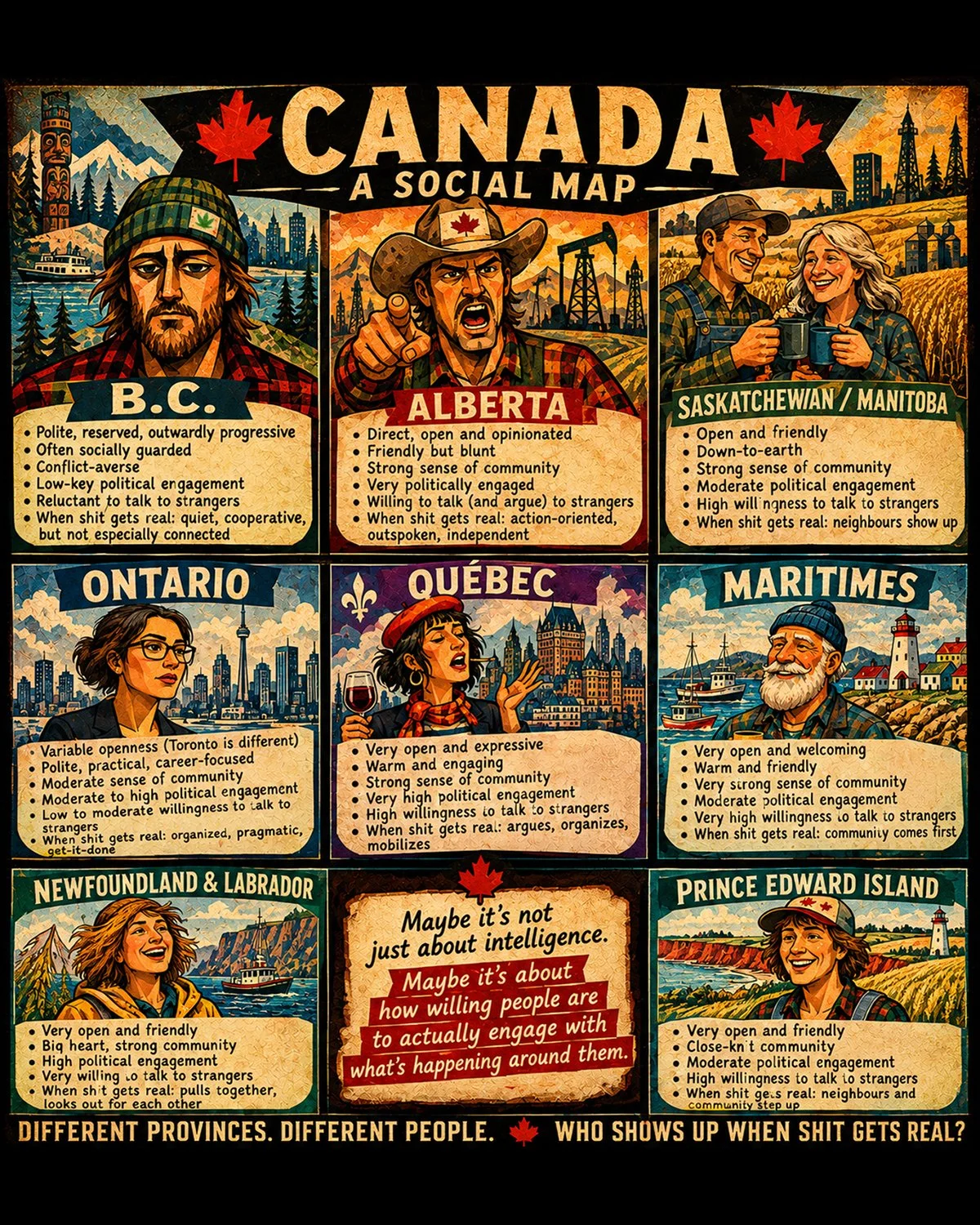
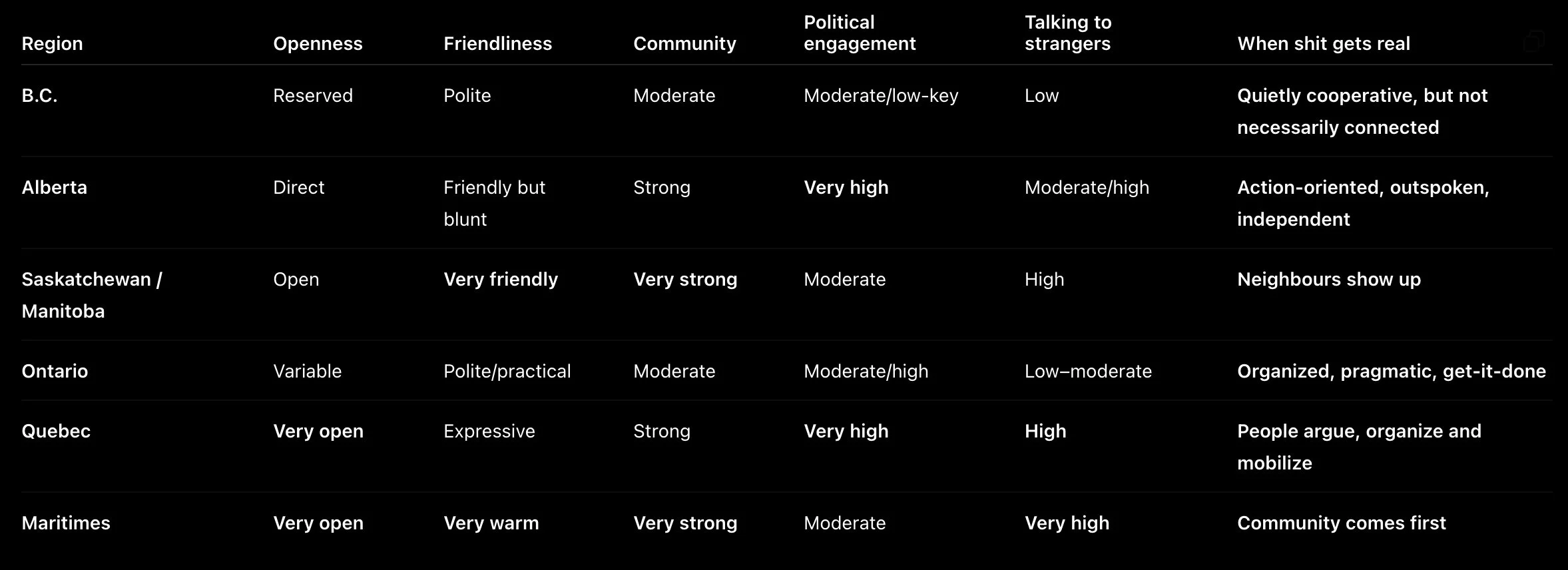
If we strip away the caricatures and look at regional culture, there are some fairly striking differences. The data doesn't support saying one province is simply “better,” but they do support the idea that Canadians in different regions have noticeably different relationships with community, politics and social interaction. For example, Statistics Canada found a strong sense of local community was reported by 48% of British Columbians versus 53% in Saskatchewan, 50% in Manitoba, 50% in New Brunswick, 52% in P.E.I. and 55% in Newfoundland and Labrador. [Statistics Canada]
B.C.
The odd one.
Beautiful, educated, progressive, environmentally conscious and often socially guarded. Vancouver especially can have a “don't intrude on my bubble” quality. You can encounter enormous numbers of people without actually becoming part of their lives.
Interestingly, B.C. isn't dramatically different from the national average on institutional confidence: Statistics Canada put B.C. at 24% reporting high confidence in institutions in 2023, compared with 25% Ontario and 27% the Prairies. ([Statistics Canada][2])
The difference may be less about what people believe and more about how much they want to engage with one another about it.
Alberta
Almost the opposite social temperament.
Albertans tend to be more comfortable saying “I disagree with you.” Politics is much more openly discussed, and provincial identity is unusually strong. Environics research consistently identifies Alberta as one of Canada's most distinctive political cultures. [Environics Research]
When something goes wrong, the stereotype is:
“Okay. What are we going to do about it?”
There's also a genuine downside: Alberta can be highly polarized. Research has found unusually large ideological divides within the province. [Environics Institute for Survey Research]
Saskatchewan & Manitoba
This is probably Canada's strongest “neighbour” culture.
Less concerned with appearances, more inclined toward practical help. The Statistics Canada numbers support that general impression: Saskatchewan had a 53% strong-local-belonging rate and Manitoba 50%, compared with 48% in B.C. [Statistics Canada]
The social expectation is more:
> “You need a hand? Sure.”
rather than:
> “Oh, that's unfortunate. Anyway…”
Ontario
Ontario is difficult because Toronto isn't Ontario.
Toronto can be intensely private, career-oriented and transactional. Outside the GTA, the social atmosphere can be considerably more relaxed.
Ontario tends toward pragmatism rather than ideological intensity. People may have strong opinions but aren't necessarily interested in making those opinions their entire identity.
It's the Canadian equivalent of:
“Okay, enough talking. What's the solution?”
Quebec
This is probably the biggest contrast with B.C.
Quebec has a much stronger culture of public argument, cultural identity and political participation. People are considerably more comfortable having opinions and expressing them.
And contrary to the stereotype that Quebecers are somehow less engaged with Canada, research finds Quebecers' confidence in democratic institutions is actually broadly comparable to the rest of Canada; their distinctiveness shows much more strongly in identity and cultural outlook.
[Environics Institute for Survey Research]
Socially, there's also more permission to talk to people.
A conversation doesn't necessarily need a purpose.
That's a huge cultural difference.
The Maritimes
Probably the strongest human-scale community culture of the bunch.
Conversation is social currency. Storytelling is social currency. Knowing your neighbour matters.
And the numbers are striking: Newfoundland and Labrador had the highest strong-local-belonging figure in Statistics Canada's comparison at 55%, followed by P.E.I. at 52%, with Nova Scotia at 49% and New Brunswick at 50%. [Statistics Canada]
It's also worth noting that Atlantic Canada had 23% high confidence in institutions in 2023 - about the same as B.C. and Ontario - so “community-oriented” doesn't necessarily mean blindly trusting authorities. [Statistics Canada]
So, if we're talking about the “zombie apocalypse” test…
Obviously this is hypothetical, but the cultural stereotypes would look something like:
B.C.:
“Has everyone checked the emergency app?”
Ontario:
“Okay, who's coordinating this?”
Alberta:
“Fuck it. I'll go.”
Saskatchewan/Manitoba:
“Who needs a truck?”
Quebec:
“Wait. We're going to organize this properly.”
Maritimes:
“Come inside. We've got food. Who else needs a place to stay?”
And that's perhaps the real distinction you're getting at.
B.C. isn't necessarily less intelligent, less caring or less capable. It's often just more socially self-contained.
The strongest contrast is probably:
B.C. → personal autonomy
Alberta → individual action
Prairies → neighbourly cooperation
Ontario → practical organization
Quebec → collective expression
Maritimes → communal belonging
And that helps explain why someone can feel profoundly lonely in Vancouver while being surrounded by perfectly nice people - and then go to Montreal or Halifax and suddenly find people much easier to actually engage with. The national data on belonging and trust don't prove that entire explanation, but they certainly don't make the feeling look crazy.
[Statistics Canada]
People in Quebec may argue with you.
People in Alberta may fight with you.
People in B.C. may politely change the subject.
And if you're someone who actually wants to talk about something, that last one can be maddening.
Assess Canada Threat
Does the threat of military movement against Canada increase as the USA loses the war against Iran?
Yes — the risk environment around Canada has become more serious, but I would distinguish that from saying there is a high or imminent risk of the U.S. launching military action against Canada.
The timing matters because the U.S.–Iran war is currently entering another dangerous phase. On August 30, the U.S. resumed strikes against Iranian forces after roughly a month without direct U.S. attacks, and Iran retaliated against U.S. bases in Jordan. The conflict has now lasted more than six months. (Reuters)
What could make Canada more vulnerable?
There are three separate issues worth watching.
1. A prolonged Iran war puts additional strain on the U.S. military.
If the U.S. is losing aircraft, personnel, munitions, ships, money and strategic flexibility in Iran, Washington has fewer resources available elsewhere. That does not automatically make Canada a target, but it can make American strategic thinking more aggressive about securing North America.
And there are already reports of serious pressure on U.S. military commanders as the Iran war drags on. (The Times of India)
2. U.S.–Canadian relations are exceptionally bad right now.
This is the part I would take more seriously than the Iran connection itself.
The Trump administration has continued to make statements questioning Canada's ability to defend itself. Most recently, Vice President JD Vance said that Canada could face invasion without American military protection. (Anadolu Ajansı)
At the same time, the trade relationship has deteriorated sharply, with Canada preparing additional retaliatory tariffs after negotiations collapsed. (The Guardian)
That combination — military rhetoric + economic warfare + repeated questioning of Canadian sovereignty — is unusual between two countries that have historically been extraordinarily close.
3. Canada's dependence on the U.S. for continental defence is becoming strategically important.
This is the really interesting part.
Canada and the U.S. are deeply integrated through NORAD. NORAD isn't simply an American military organization operating in Canada; it is a binational command responsible for aerospace warning, aerospace control and maritime warning for North America. (NORAD)
So if Washington and Ottawa were to move toward an actual military confrontation, the existing defence architecture itself would become a huge strategic problem.
And that's precisely why Canada has been strengthening relationships with European/Nordic countries and looking at greater Arctic defence independence. (The Economic Times)
But here's the important distinction
I wouldn't interpret the current situation as evidence that the U.S. is preparing to invade Canada because it is losing in Iran.
There isn't good evidence of that.
What I would say is:
The longer the Iran war goes badly for Washington, the more important control of the North American strategic environment becomes to the United States — and Canada's increasing political independence could become more irritating to an administration already demonstrating a willingness to use coercion against allies.
That's a different proposition from "America is going to invade Canada."
What would make me genuinely concerned?
I'd watch for concrete military indicators, rather than political rhetoric:
unusual U.S. troop movements toward the Canadian border
large-scale deployment of armor or combat units to northern U.S. bases
significant changes to NORAD command arrangements
U.S. military exercises specifically oriented toward Canadian territory
evacuation or protection measures around U.S. diplomatic facilities in Canada
unusual movements of National Guard units
closure/restriction of border crossings for security reasons
Canadian military mobilization beyond normal Arctic/NORAD activity
U.S. government documents explicitly identifying Canada as a military contingency
sudden changes to U.S. rules governing military operations in the Arctic
Those would mean much more than Trump's or Vance's statements.
In fact, NORAD was still conducting normal binational homeland-defence activities as recently as late August, including a major weapons-and-tactics conference and Arctic capability planning. (NORAD)
The bigger danger may be indirect
There's another scenario I think is considerably more plausible:
Iran war → U.S. military overstretch → economic/strategic pressure on Canada → Canadian refusal to follow Washington → escalating political confrontation → increased U.S. pressure on Canadian defence and Arctic policy.
That's much more realistic than suddenly seeing American tanks crossing the border.
And there's an additional wrinkle: Canada already has military personnel and command relationships in the Middle East, while Ottawa has tried to avoid being pulled directly into the Iran war. Canada has previously resisted American pressure to become more militarily involved. (CityNews Halifax)
So if the Iran war deteriorates badly for Washington, one thing I'd watch very closely is whether the U.S. starts demanding substantially more from Canada — bases, intelligence, Arctic access, naval support, air defence, or participation in Middle Eastern operations.
That could become a much more serious Canada–U.S. confrontation than the question of an outright invasion.
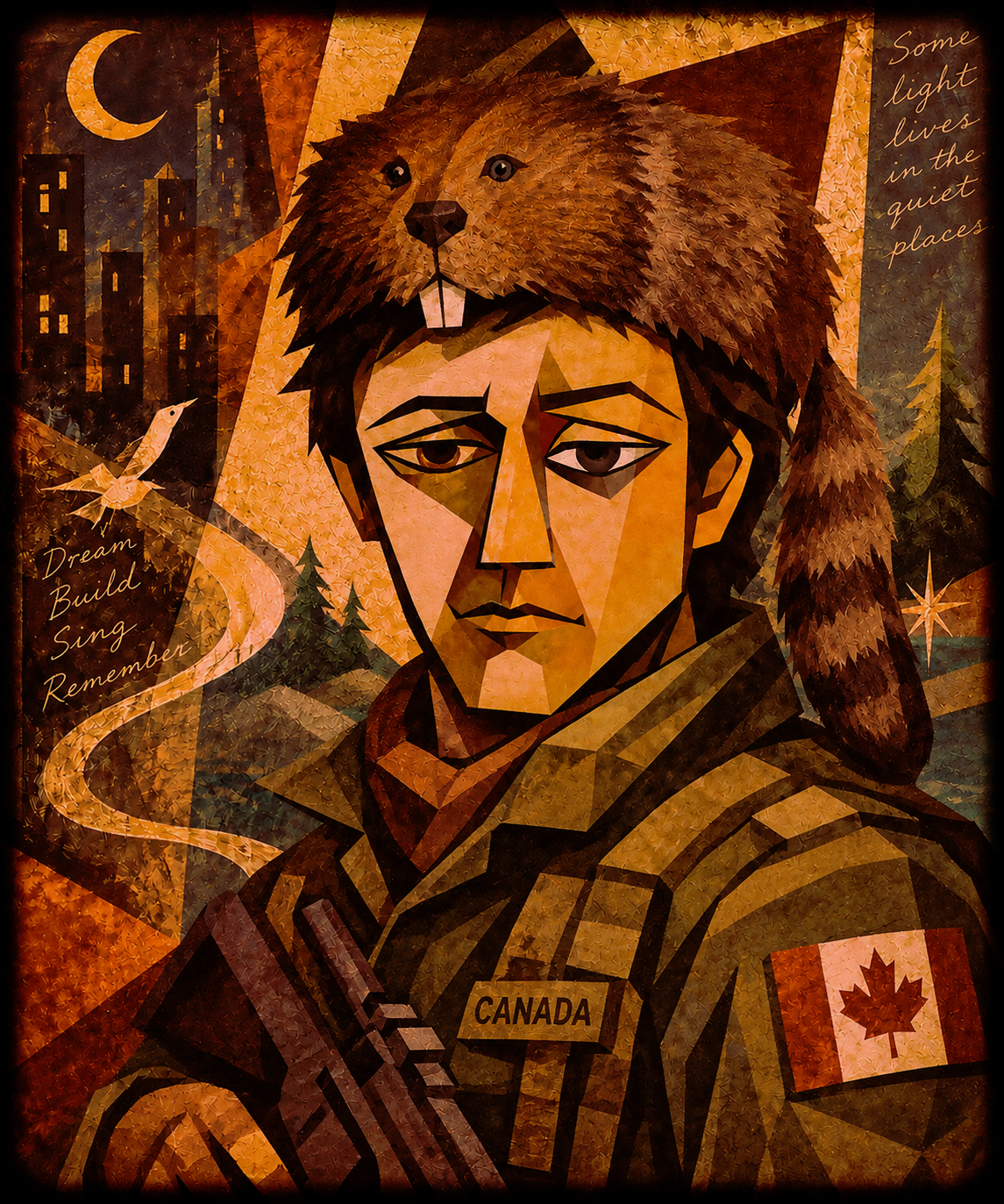
Bottom line: I would raise the geopolitical risk assessment from "remote and essentially theoretical" to "something worth actively monitoring." But I would not currently characterize military action against Canada as imminent or even the most likely outcome. The Iran war increases the importance of the Canada question; it doesn't by itself create a reason for Washington to attack Canada.