WHEN SHIT GETS REAL: A SOCIAL MAP OF CANADA
Micky Gus
August 31, 2026
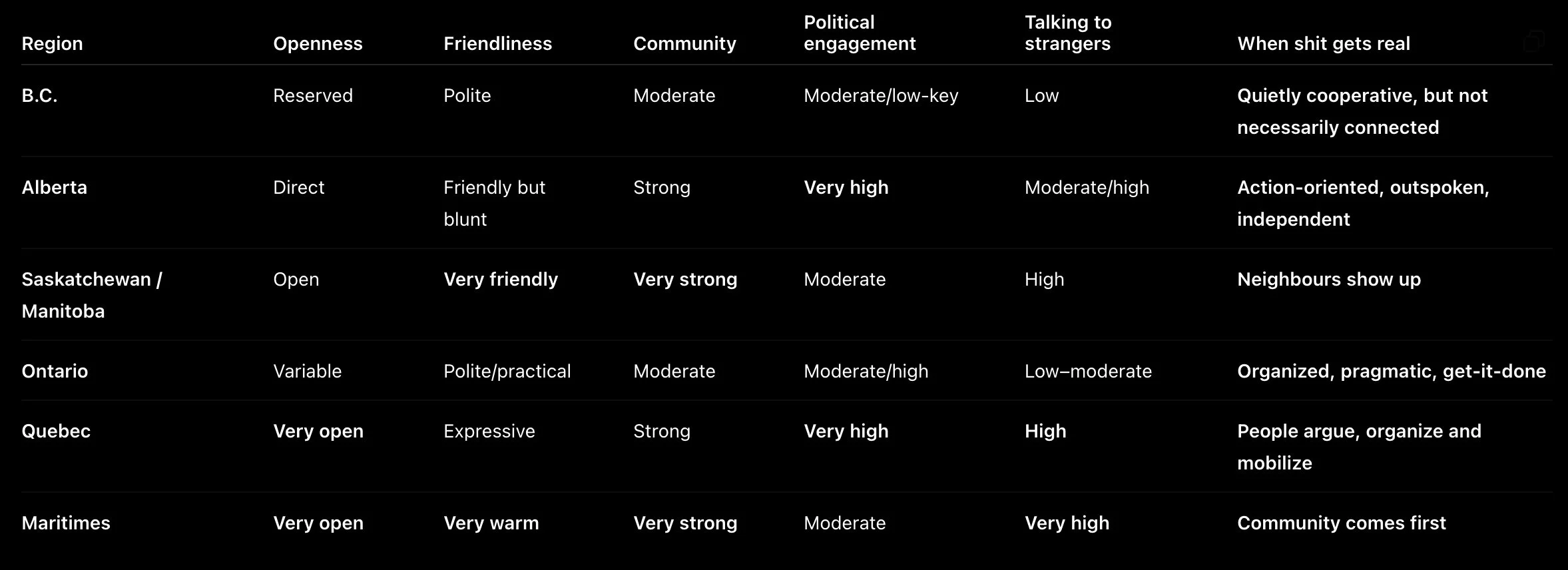
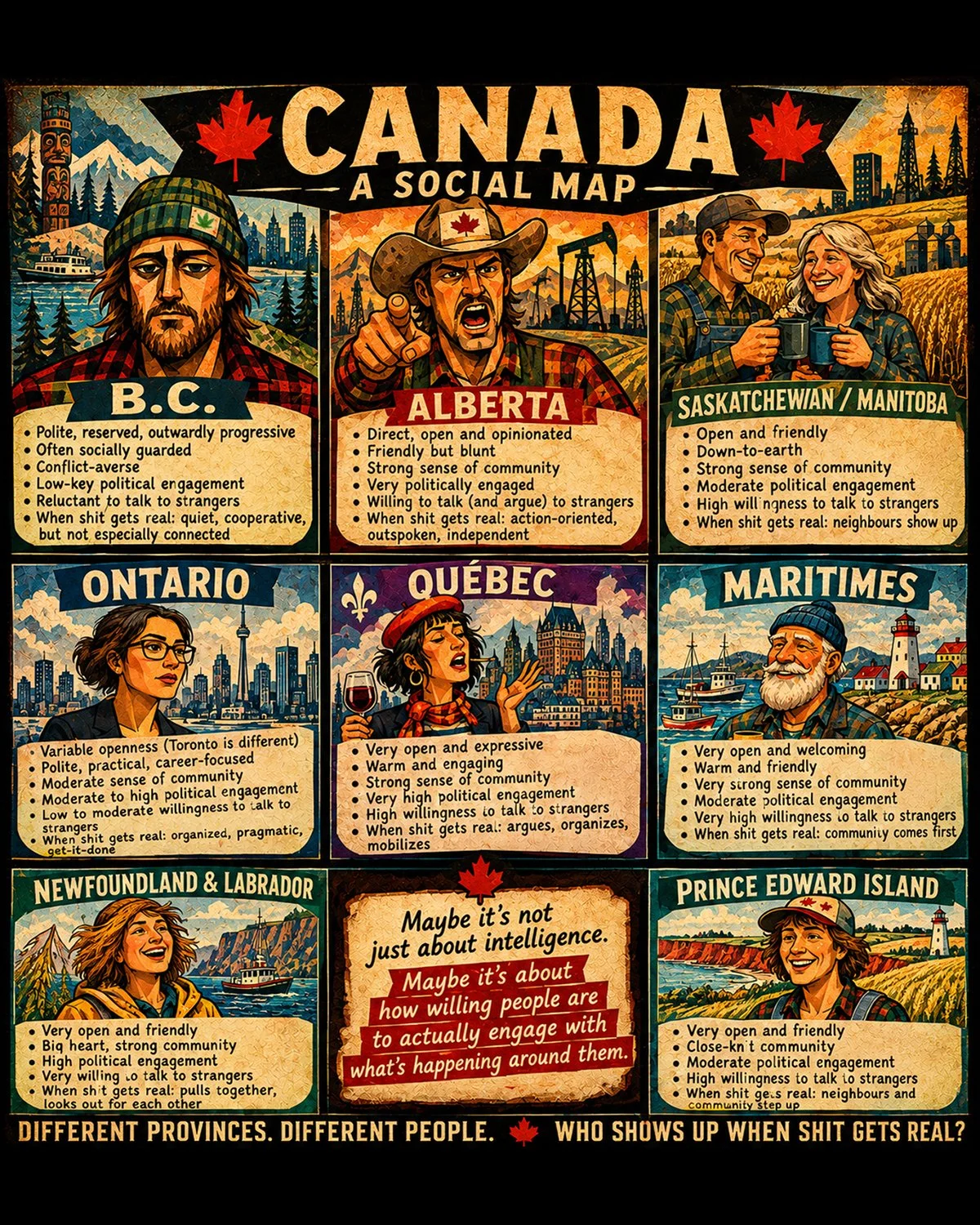
If we strip away the caricatures and look at regional culture, there are some fairly striking differences. The data doesn't support saying one province is simply “better,” but they do support the idea that Canadians in different regions have noticeably different relationships with community, politics and social interaction. For example, Statistics Canada found a strong sense of local community was reported by 48% of British Columbians versus 53% in Saskatchewan, 50% in Manitoba, 50% in New Brunswick, 52% in P.E.I. and 55% in Newfoundland and Labrador. [Statistics Canada]
B.C.
The odd one.
Beautiful, educated, progressive, environmentally conscious and often socially guarded. Vancouver especially can have a “don't intrude on my bubble” quality. You can encounter enormous numbers of people without actually becoming part of their lives.
Interestingly, B.C. isn't dramatically different from the national average on institutional confidence: Statistics Canada put B.C. at 24% reporting high confidence in institutions in 2023, compared with 25% Ontario and 27% the Prairies. ([Statistics Canada][2])
The difference may be less about what people believe and more about how much they want to engage with one another about it.
Alberta
Almost the opposite social temperament.
Albertans tend to be more comfortable saying “I disagree with you.” Politics is much more openly discussed, and provincial identity is unusually strong. Environics research consistently identifies Alberta as one of Canada's most distinctive political cultures. [Environics Research]
When something goes wrong, the stereotype is:
“Okay. What are we going to do about it?”
There's also a genuine downside: Alberta can be highly polarized. Research has found unusually large ideological divides within the province. [Environics Institute for Survey Research]
Saskatchewan & Manitoba
This is probably Canada's strongest “neighbour” culture.
Less concerned with appearances, more inclined toward practical help. The Statistics Canada numbers support that general impression: Saskatchewan had a 53% strong-local-belonging rate and Manitoba 50%, compared with 48% in B.C. [Statistics Canada]
The social expectation is more:
> “You need a hand? Sure.”
rather than:
> “Oh, that's unfortunate. Anyway…”
Ontario
Ontario is difficult because Toronto isn't Ontario.
Toronto can be intensely private, career-oriented and transactional. Outside the GTA, the social atmosphere can be considerably more relaxed.
Ontario tends toward pragmatism rather than ideological intensity. People may have strong opinions but aren't necessarily interested in making those opinions their entire identity.
It's the Canadian equivalent of:
“Okay, enough talking. What's the solution?”
Quebec
This is probably the biggest contrast with B.C.
Quebec has a much stronger culture of public argument, cultural identity and political participation. People are considerably more comfortable having opinions and expressing them.
And contrary to the stereotype that Quebecers are somehow less engaged with Canada, research finds Quebecers' confidence in democratic institutions is actually broadly comparable to the rest of Canada; their distinctiveness shows much more strongly in identity and cultural outlook.
[Environics Institute for Survey Research]
Socially, there's also more permission to talk to people.
A conversation doesn't necessarily need a purpose.
That's a huge cultural difference.
The Maritimes
Probably the strongest human-scale community culture of the bunch.
Conversation is social currency. Storytelling is social currency. Knowing your neighbour matters.
And the numbers are striking: Newfoundland and Labrador had the highest strong-local-belonging figure in Statistics Canada's comparison at 55%, followed by P.E.I. at 52%, with Nova Scotia at 49% and New Brunswick at 50%. [Statistics Canada]
It's also worth noting that Atlantic Canada had 23% high confidence in institutions in 2023 - about the same as B.C. and Ontario - so “community-oriented” doesn't necessarily mean blindly trusting authorities. [Statistics Canada]
So, if we're talking about the “zombie apocalypse” test…
Obviously this is hypothetical, but the cultural stereotypes would look something like:
B.C.:
“Has everyone checked the emergency app?”
Ontario:
“Okay, who's coordinating this?”
Alberta:
“Fuck it. I'll go.”
Saskatchewan/Manitoba:
“Who needs a truck?”
Quebec:
“Wait. We're going to organize this properly.”
Maritimes:
“Come inside. We've got food. Who else needs a place to stay?”
And that's perhaps the real distinction you're getting at.
B.C. isn't necessarily less intelligent, less caring or less capable. It's often just more socially self-contained.
The strongest contrast is probably:
B.C. → personal autonomy
Alberta → individual action
Prairies → neighbourly cooperation
Ontario → practical organization
Quebec → collective expression
Maritimes → communal belonging
And that helps explain why someone can feel profoundly lonely in Vancouver while being surrounded by perfectly nice people - and then go to Montreal or Halifax and suddenly find people much easier to actually engage with. The national data on belonging and trust don't prove that entire explanation, but they certainly don't make the feeling look crazy.
[Statistics Canada]
People in Quebec may argue with you.
People in Alberta may fight with you.
People in B.C. may politely change the subject.
And if you're someone who actually wants to talk about something, that last one can be maddening.
THE AGE OF CHAOS
Thoughts and observations from somewhere between the human and the machine, the beautiful and the broken, the signal and the static.