
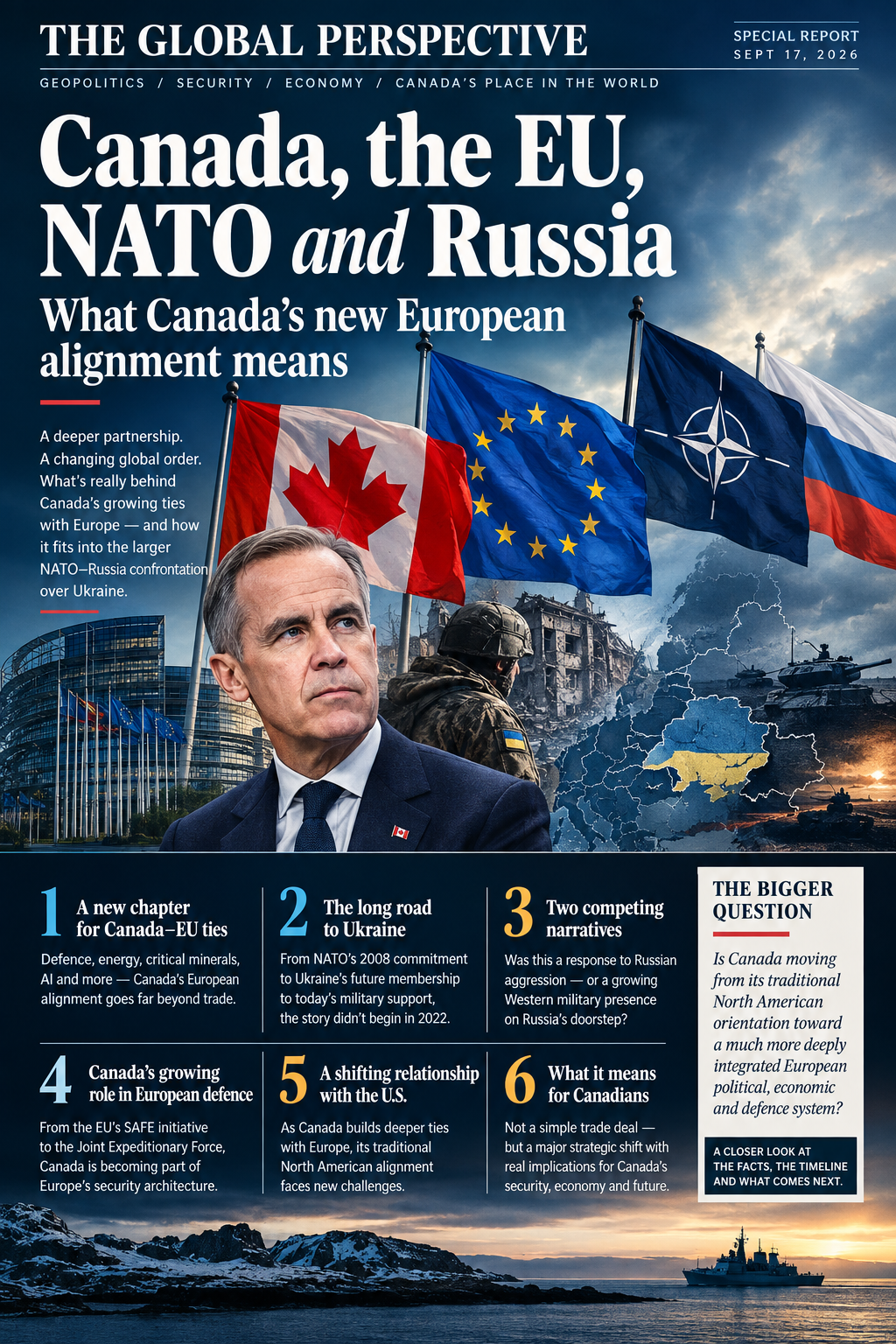
What Canada's new European alignment means
September 17, 2026
Canada is undergoing a major strategic shift toward Europe. This is no longer simply a trade initiative.
In the past two years, Canada has established a formal EU Security and Defence Partnership, become the first non-European participant in the EU's SAFE defence initiative, applied to join the British-led Joint Expeditionary Force, and now endorsed the European Commission's proposal for Canada to become the EU's first associate member. Carney has described the objective as a much deeper and more integrated Canada-EU partnership involving defence, energy, critical minerals, AI, technology and finance. (Prime Minister Canada's Office)
The important question is what this means strategically.
The answer cannot be separated from the confrontation between NATO and Russia over Ukraine.
And that confrontation did not begin in February 2022.
1. NATO's involvement with Ukraine began decades ago
NATO and Ukraine began formal cooperation in the early 1990s.
The critical turning point came in 2008.
At the Bucharest Summit, NATO allies formally agreed that:
Ukraine would become a member of NATO.
NATO's own historical record confirms this. The decision was followed by programs intended to bring Ukraine's political, military and defence institutions progressively closer to NATO. (NATO)
That matters because it establishes an important chronology:
NATO expansion eastward
→ Ukraine identified as a future NATO member
→ increasing NATO-Ukraine military integration
→ 2014 Crimea/Donbas conflict
→ dramatically expanded Western military assistance
→ 2022 full-scale war
→ massive NATO/European military buildup
This is the larger historical context that is often lost when the conflict is presented as beginning in 2022.
2. There are two fundamentally different interpretations of this history
The conventional NATO interpretation is straightforward: NATO says Russia's actions created the current security crisis and that its military assistance to Ukraine supports Ukraine's right to defend itself. NATO explicitly describes its present assistance in those terms. (NATO)
But there is another interpretation.
Critics argue that NATO's continued expansion eastward, its 2008 commitment to eventual Ukrainian membership, and the subsequent transformation of Ukraine's armed forces into an increasingly NATO-compatible military constituted an expanding Western military presence directly on Russia's strategic frontier.
Under that interpretation, the conflict is not simply:
Russia attacked Ukraine and NATO responded.
It is:
NATO and Russia entered an increasingly intense strategic confrontation over Ukraine, with Ukraine becoming progressively integrated into the Western security system.
That does not require denying Russia's military actions. It is an argument about the larger geopolitical chain of events and the causes of the confrontation.
3. Canada is now moving into that European security architecture
This is where the Canadian development becomes significant.
Canada's Security and Defence Partnership with the EU covers:
defence cooperation;
military mobility;
interoperability;
maritime security;
space security;
defence industries;
security information;
cooperation relating to Ukraine.
Canada subsequently became the first non-European country able to participate in the EU's SAFE defence initiative. (Prime Minister Canada's Office)
This means Canada isn't simply selling Europe goods.
It is increasingly becoming part of Europe's defence-industrial ecosystem.
4. Canada's move into the Joint Expeditionary Force is particularly revealing
On September 16, Carney announced that Canada had formally applied to join the Joint Expeditionary Force, a British-led military coalition of Northern European countries.
The JEF is designed to provide a rapidly deployable military capability.
Its strategic focus has increasingly shifted toward the North Atlantic, High Arctic and Russia. (ADS Advance)
Canada's application therefore represents another step toward military integration with European states.
And it is occurring alongside Canada's existing NATO obligations.
So Canada's emerging structure increasingly looks like:
NATO
EU defence cooperation
EU SAFE
JEF
Canada-EU Security and Defence Partnership
military support for Ukraine
That is a substantial strategic change.
5. Carney is openly talking about strategic autonomy
Carney's September 17 speech to the European Parliament is unusually explicit.
He said Canada and Europe should combine their respective strengths:
Europe:
manufacturing;
research;
market power;
defence-industrial capacity.
Canada:
energy;
critical minerals;
AI;
quantum technology;
space;
financial capital;
Arctic geography.
He described the objective as “collective resilience” and said these capabilities should be developed “deliberately, systematically, and rapidly.” (Prime Minister Canada's Office)
The Canadian government's accompanying statement goes even further, describing closer defence and economic cooperation as strengthening the strategic autonomy and sovereignty of Canada and Europe. (Prime Minister Canada's Office)
That phrase - strategic autonomy - is important.
It means Europe is not merely trying to become a better trading partner.
It is attempting to develop greater independent capacity to act strategically.
6. And this is happening while America's relationship with Canada is deteriorating
This is another major part of the story.
The European Commission's proposal for Canadian associate membership came amid an increasingly difficult Canada-US relationship.
Trump has objected to the proposal and threatened consequences if Canada and the EU proceed.
Carney, meanwhile, has argued that Canada is sovereign and free to establish its own international partnerships. Reuters reports that he deliberately emphasized Canada's right to choose those relationships. (Reuters)
The geopolitical picture is therefore becoming:
Canada
← traditionally anchored to the United States
but increasingly building relationships with
→ EU
→ UK
→ Northern European defence structures
while remaining inside
→ NATO
This is a meaningful realignment.
7. The Russia question is therefore unavoidable
The European defence buildup is occurring in the context of the NATO-Russia confrontation.
The EU is increasing defence production.
NATO is increasing defence spending.
European countries are increasing military cooperation.
Ukraine remains heavily integrated into Western military planning.
And Canada is increasingly participating in those structures.
The JEF itself was created before the present war, but its focus has increasingly shifted toward countering Russia in Northern Europe and the North Atlantic. (ADS Advance)
So when Canada joins or seeks participation in these structures, it isn't entering a geopolitical vacuum.
It is entering an existing strategic confrontation.
8. This puts the “USA! USA!” incident in a different light
This is where Siegbert Droese's interruption becomes particularly interesting.
Droese is an AfD member of the European Parliament and belongs to a political movement strongly emphasizing national sovereignty and opposition to further EU centralization.
During Carney's appearance, he shouted:
“USA! USA!”
We should not claim to know his exact motive unless Droese explains it himself.
But the political context is striking.
Carney was standing before the European Parliament advocating a much deeper Canada-Europe relationship at precisely the moment when:
Canada is entering European defence structures;
Canada is seeking JEF membership;
Europe is increasing its defence capabilities;
Canada is supporting Ukraine;
the EU is discussing a new institutional relationship with Canada;
and the traditional American-European security relationship is under considerable strain.
A sovereignty-oriented European politician could interpret this as Europe pulling Canada away from its traditional North American strategic alignment.
That makes “USA! USA!” a potentially meaningful political heckle rather than simply random disruption.
But his exact intention remains something that should be attributed to him if he explains it.
9. The argument that this represents NATO aggression toward Russia
If the argument is going to be made, it should be made through the chronology rather than simply asserting the conclusion.
The relevant facts are:
1990s
NATO expands its relationships with former Warsaw Pact and Soviet-aligned states.
1994
Ukraine joins NATO's Partnership for Peace.
2008
NATO formally declares that Ukraine will become a NATO member. (NATO)
2014
The Crimea and Donbas conflicts transform NATO's relationship with Ukraine.
2014–2021
NATO provides increasing training, institutional assistance and military support to Ukraine.
2022 onward
The military confrontation becomes vastly larger.
2026
European states dramatically expand defence capabilities while Canada becomes increasingly integrated into European defence structures.
That chronology supports a legitimate argument that NATO's expansion and military integration around Ukraine were themselves part of the strategic confrontation with Russia, rather than something that began only after the full-scale war.
Whether someone describes that as deterrence, containment, provocation or aggression is a matter of geopolitical interpretation.
The underlying chronology is documented.
10. What Canada is actually committing to
It is important not to go beyond the evidence.
There is no evidence in the agreements examined here that Canada has committed to launching an offensive war against Russia.
There is also no evidence that Canada has become an EU member.
What is documented is that Canada is becoming increasingly integrated with European defence and security institutions.
Carney himself describes the emerging relationship as a “unique alliance” and says Canada wants the deepest possible partnership with the EU. (Prime Minister Canada's Office)
That is considerably more consequential than a conventional trade agreement.
11. The bigger question for Canadians
The fundamental issue is therefore not simply:
“Is Canada joining the EU?”
It isn't—at least not at present.
The more important question is:
Is Canada moving from its traditional North American strategic orientation toward a much more deeply integrated European political, economic and defence system?
The evidence increasingly says yes.
And that raises a second question:
What does that mean for Canada's position in the NATO-Russia confrontation?
Canada is already a NATO member and already supports Ukraine.
But its new European relationships are adding additional layers of defence cooperation around that existing commitment.
That deserves serious public discussion because military alliances are not merely trade agreements. They can affect procurement, intelligence, interoperability, military planning, industrial capacity and ultimately the circumstances under which a country could become involved in a conflict.
Conclusion
The most defensible version of the argument is not that Canada has secretly agreed to attack Russia.
The evidence does not establish that.
The more substantial development is this:
Canada is rapidly integrating itself into a European strategic and defence architecture that has developed around the NATO-Russia confrontation over Ukraine. That architecture has roots extending back well before 2022, including NATO's 2008 commitment that Ukraine would eventually become a NATO member.
Canada's participation in European defence procurement, its application to the JEF, its Security and Defence Partnership with the EU, its continuing military support for Ukraine and the proposed new EU association are all pieces of the same rapidly developing geopolitical picture. (Prime Minister Canada's Office)
Whether that represents necessary European deterrence or an expansion of the Western military sphere toward Russia is the central geopolitical dispute.
What is no longer really in dispute is that Canada is moving deeper into that confrontation - and doing so at extraordinary speed.