
PM Carney is stalling. Canada is aligning with China, which some claim is assisting Iran with navigation systems. He's quietly preparing Canada for future geopolitical developments.
Movements in Canada critical of Iran and supportive of United States and Israel are alleged by some to be influenced by foreign intelligence to be leveraged as a pretext for something bigger in Canada.
There is no way the US will risk having Chinese military on their border via Canada. It's likely, and there has been public concern, that's already started very covertly. The USA will make a move first.
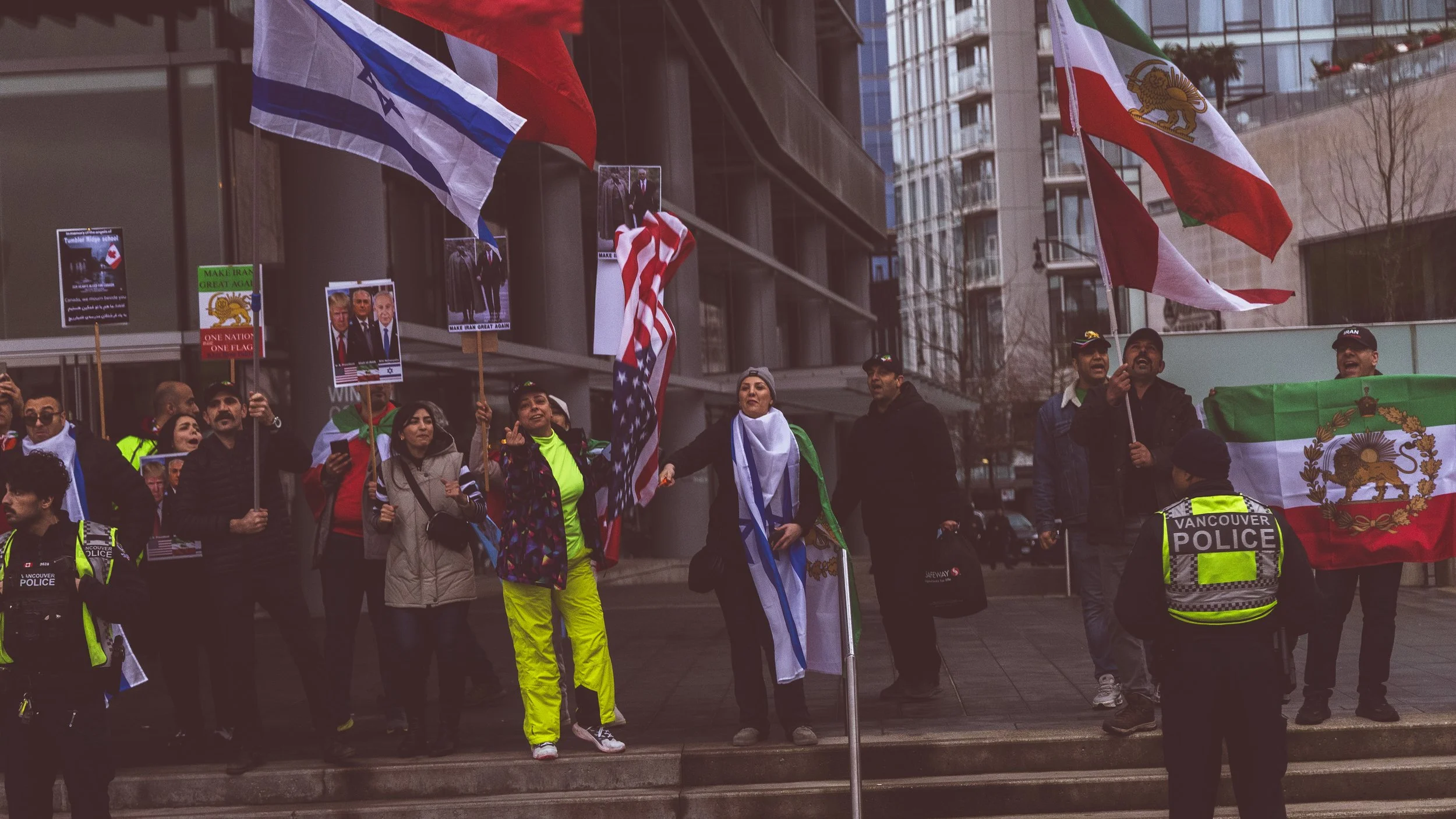

The propaganda has worked
The propaganda has worked. People have become afraid to speak up against war.
Apparently being anti-war now gets translated as antisemitic.
Funny how opposing bombs suddenly means you hate an entire religion.
Almost like the goal is to make people afraid to criticize a war.
Wild how fast “don’t bomb people” gets rebranded as antisemitism.
Criticizing a government’s war isn’t the same as hating a people, but apparently that nuance is inconvenient.
Some people hear “maybe stop the war” and immediately translate it to “antisemitism.”
That’s not moral clarity - that’s intellectual laziness.
Being anti-war used to mean you were anti-war.
Now, if the wrong government is involved, suddenly you’re accused of antisemitism.
Convenient little shield for avoiding criticism.

Canadian Attitudes Towards War
1. Historical and Political Context
Canada, especially on the west coast, has never experienced large-scale wars on its own soil in modern history. Unlike Europe or parts of Asia, where war is a constant, visible reality, Canadians grew up with war as a distant concept—mostly as “something that happens overseas.” That tends to foster a cultural distance from conflict, which can translate into less vocal anti-war activism.
Moreover, Canada’s foreign policy has often emphasized peacekeeping, diplomacy, and multilateralism in international forums. While this is admirable, it can create a national narrative of moral high ground, where speaking out against war can feel unnecessary or even contrary to “the Canadian way.”
2. Social Norms and Civility
Canadian culture—particularly in urban west coast areas like Vancouver—places a high value on politeness, social harmony, and consensus. There’s a deeply ingrained social pressure to avoid confrontation, even about moral issues. So, people may internally disagree with wars or atrocities, but they might not vocalize it, especially in mixed company.
3. Media Environment
Canadian media often covers conflicts through a framing lens set by Western powers, and there’s less sensationalist or activist journalism compared to some other countries. When war is always “over there” and reported in a neutral or diplomatic tone, it’s easy for public outrage to feel abstract rather than urgent.
4. Psychological Distance and Comfort
The west coast in particular has a relatively high standard of living, low immediate threat environment, and geographic isolation from conflict zones. Psychologically, people are more likely to prioritize personal safety and comfort over global activism. There’s also what social scientists call moral buffering: the feeling that “someone else is taking care of it,” which reduces individual responsibility to speak out.
5. Comparison With Other Societies
In places with frequent wars, oppressive regimes, or systemic injustice (like parts of Europe during WWII, Latin America in the 1970s, or even the U.S. during the Vietnam era), citizens are often forced into political engagement—because the cost of silence is tangible. In Canada, the cost of staying silent is socially minimal, so less resistance is visible.
shaped by media
With almost any group of Westerners/Canadians, it only takes a few minutes before someone reveals how heavily shaped by media narratives they are.
It starts with things like believing there’s still such a thing as real “democracy,” or that some politician or prime minister is genuinely there for the people. The current PM wasn’t even elected in a general election — he was placed into the position through a party leadership process then followed up by a charade of an election.
Then someone inevitably starts repeating cartoon-level ideas as if they think there's a rabid pack of Muslims out there who hate us for our “freedoms,” without any awareness that Western countries have spent decades bombing, invading, and destabilizing large parts of their region.
Or I’ll have to listen to someone talk about how a drone-bombing war criminal like Barack Obama was a great president while simultaneously parroting whatever slogans they heard from friends about Trump being an “orange conman.”
Yes — he is. But snap out of it.
Both sides of the spectacle run on the same shallow talking points.
It was the same during COVID. Suddenly everyone turned into an enforcer — pressuring friends, shaming people about vaccines, repeating whatever lines were circulating that week. The same people who talk endlessly about “freedom” had no problem piling on when social pressure was in style.
Then when the trucker protests happened, they suddenly found their voice — not because of principles, but because they felt personally inconvenienced or affected. When something touches their daily comfort, they become loud overnight.
But when the subject is endless war, proxy conflicts, or the growing risk of World War III, the same people are strangely quiet again.
That’s the pattern.
People only speak out when it affects their immediate comfort.
Otherwise they remain silent, passive, and perfectly content repeating whatever narrative is circulating around them.
What I almost never encounter are independent, critical thinkers.
Instead, I keep finding myself surrounded by programmed sheep, walking around with spirals in their eyes, repeating whatever narratives were installed in them.
Generational Media Conditioning and the Entrenchment of Belief in the Postwar Information Environment
The difficulty many members of the Baby Boomer generation experience in reconsidering long-held political and historical beliefs can be understood less as individual stubbornness and more as the result of a uniquely powerful media and institutional environment that shaped their worldview during formative decades. Born roughly between 1946 and 1964, Boomers came of age in a period when mass communication was highly centralized, trust in institutions was culturally reinforced, and dissenting narratives were often marginalized. This combination produced a durable cognitive framework in which official narratives were assumed to be fundamentally reliable. Over time, the psychological and social investments tied to those beliefs have made reassessment increasingly difficult, even when contradictory evidence emerges.
During the mid-20th century, the information landscape in North America and much of the Western world was dominated by a small number of gatekeepers: national television networks, major newspapers, government institutions, and a relatively narrow academic consensus. Unlike the fragmented digital media environment of today, the period from the 1950s through the 1980s presented information to the public through a highly curated set of channels. The concentration of authority created what sociologists sometimes describe as a “high-trust information regime.” News anchors, government officials, and experts were widely perceived not merely as sources of information but as arbiters of truth. As a result, narratives presented repeatedly through these channels acquired a strong presumption of legitimacy.
This structure had powerful psychological consequences. Repetition, authority cues, and social consensus are among the most effective mechanisms for shaping belief. When individuals encounter the same framing across multiple trusted institutions—schools, television, newspapers, and government messaging—the ideas become embedded as background assumptions rather than propositions requiring continual verification. For Boomers, these assumptions often formed during childhood or early adulthood, the developmental stages when political identity and historical understanding become most durable.
Once such beliefs are integrated into personal identity, several well-documented cognitive processes reinforce them. Confirmation bias encourages individuals to favor information that supports their existing worldview, while cognitive dissonance avoidance discourages engagement with evidence that threatens it. Over decades, these mechanisms can transform institutional narratives into what feels like lived truth. Importantly, rejecting those narratives later in life may require not just revising a fact but reinterpreting an entire lifetime of political and cultural experience.
Another factor is the emotional and social cost of reassessment. Many Boomer identities are intertwined with historical milestones they witnessed—Cold War politics, economic expansion, national conflicts, and cultural transformations. If key elements of the stories told about these events are challenged, it can feel as though one’s own memories and judgments are being called into question. The result is often defensive resistance rather than curiosity. In this sense, what appears externally as inflexibility may internally function as a form of psychological self-preservation.
The generational contrast with younger cohorts further intensifies this dynamic. People who grew up in the internet era are accustomed to a chaotic information ecosystem where competing narratives coexist and institutional authority is routinely questioned. For Boomers, however, such fragmentation can appear not as healthy pluralism but as disorder or misinformation. Consequently, they may interpret challenges to long-standing narratives as attacks on stability rather than legitimate reinterpretations of history.
None of this implies that every member of the Boomer generation shares identical views or that critical thinkers do not exist within it. Generational generalizations inevitably simplify a complex reality. However, the broader pattern suggests that the information environment of the mid-20th century created particularly strong narrative frameworks that are resistant to revision. The issue is therefore less about intellectual capacity and more about historical conditioning: a lifetime spent trusting institutions that once operated with far less visible competition in the marketplace of ideas.
Understanding this dynamic is essential for productive dialogue across generations. Attempts to change entrenched beliefs through confrontation or ridicule tend to reinforce defensive reactions. More effective approaches emphasize historical context, empathy for how those beliefs formed, and gradual exposure to alternative perspectives. In other words, overcoming deeply embedded narratives is not primarily an argument to be won but a process of reframing how information and authority are understood.
In this light, the persistence of Boomer beliefs should not be seen simply as stubborn adherence to outdated ideas but as the predictable outcome of a powerful and cohesive media system that shaped an entire generation’s perception of reality. Recognizing that conditioning—rather than dismissing it—offers the best chance of bridging the divide between inherited narratives and emerging interpretations of history.
Project MKUltra
🐇 Project MKUltra was a project run by the Central Intelligence Agency (CIA). It began in 1953 and involved secret experiments on mind control, interrogation, and behavior modification, often using drugs such as Lysergic acid diethylamide (LSD).
Canadian university involved
The most famous Canadian site connected to MKUltra research was McGill University in Montreal, specifically the Allan Memorial Institute, a psychiatric hospital affiliated with McGill.
The experiments there were led by psychiatrist Donald Ewen Cameron.
What happened there
Cameron ran controversial experiments in the 1950s–1960s that included:
Extremely high doses of LSD
Electroconvulsive therapy at intensities far beyond normal treatment
Long periods of drug-induced sleep
“Psychic driving” — repeatedly playing recorded messages to patients while they were sedated
Many patients were not informed about the real nature of the experiments and had entered the hospital for relatively routine psychiatric treatment.
CIA involvement
The CIA funded Cameron’s work covertly through front organizations, mainly the Society for the Investigation of Human Ecology, which disguised the intelligence connection.
Later revelations
The program became public during the Church Committee investigations in the United States.
Afterward:
Several Canadian victims sued the CIA and the U.S. government.
Some eventually received financial settlements in the 1980s and 1990s.
Important note
Not every experiment Cameron conducted was officially listed as MKUltra subprojects, but CIA funding is well documented, and the Allan Memorial Institute is widely cited as one of the most prominent non-U.S. locations linked to MKUltra research.